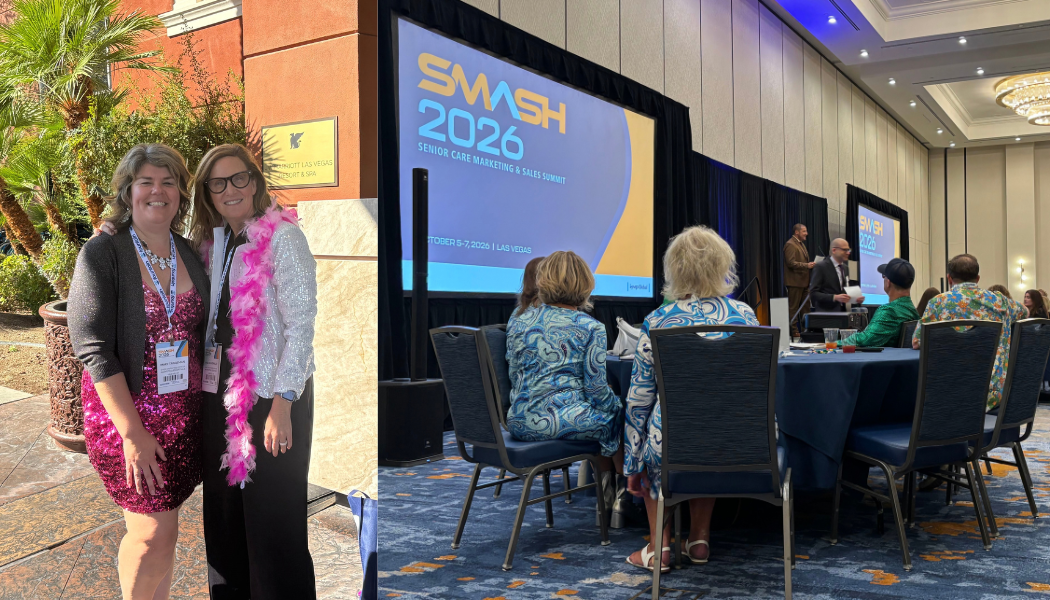
If this year’s Senior Care Marketing & Sales Summit (SMASH) in Las Vegas had an unofficial theme, it was this: the way families find, choose and trust senior living is changing faster than ever.
AI is driving much of that change. It came up in every room, every hallway conversation and every dinner. Senior living organizations can no longer watch it from the sidelines, and everyone is asking how to use it to work smarter, understand their prospects better and create stronger experiences for families.
As a senior living marketing agency, we value nothing more than the chance to sit down face-to-face with members of the senior living community and talk about what they’re experiencing right now. Events like SMASH give us that opportunity to connect and bring home new ideas and tools we can put to work for them.
Today Is the Slowest Day
The keynote, “Leading Organizational Change: When the Future Won’t Sit Still,” with Mathew Sweezey, SVP of AI Products & Transformation at Monks, set the tone right away. Sweezey laid out a simple truth about AI that really resonated with me: “Today is the slowest day.”
AI is getting more capable exponentially. The length of tasks it can handle is doubling roughly every seven months, and the cost of using it has dropped dramatically.
The line that stuck with me: “The winners won’t be the companies that use AI the most. They’ll be the companies that redesign themselves fastest around what AI makes possible.”
He described three levels of organizational change:
- Adopt. Individuals use AI tools to complete tasks faster.
- Rewire. Teams redesign entire workflows around AI, with clear goals, roadmaps and ownership.
- Reinvent. The organization rebuilds its operating model for an AI-native world.
His point was that “it’s not about the model. It’s about the mix.” Great organizations work at all three levels at once, depending on the problem in front of them. He also offered a healthy reality check: focus on the goals, not AI. Rolling out AI is not a goal. Many of the gains people attribute to AI can actually come from simple automation and consolidation.
He even shared an example that felt tailor-made for senior living. In an AI-native sales process, AI handles lead qualification, outreach, scheduling and follow-up, “leaving humans to do what they do best.” For stretched-thin sales teams, that’s a future worth planning for now.
AI Changed Content. It Didn’t Change People.
In her breakout session, “Story Blueprint Lab: The Narrative That Moves People,” Miri Rodriguez, CEO of Empressa AI, bestselling author of Brand Storytelling and former Storytelling Leader at Microsoft, offered a timely reminder: AI has changed how quickly we can create content, but it hasn’t changed the people we’re trying to reach.
That message lands especially hard in senior living, where every decision is emotional. Families aren’t simply comparing floor plans and amenities. They’re working through questions of identity, independence, safety, family, change, belonging and trust. Long before they schedule a tour, they’re asking themselves, “Can I see myself — or someone I love — here?”
Miri challenged us to stop leading with what we want people to know and instead lead with what the person on the other side needs to understand, feel or believe. As she put it, “Story begins with empathy — not messaging.” She walked us through her Story Blueprint, a framework built on Human, Tension, Truth, Transformation, Proof and Action. Then she showed how that same blueprint can guide AI tools, helping them tell a community’s story without inventing facts or losing its warmth.
Her closing message was simple: AI can accelerate the story, but humans remain accountable for it. Before anything ships, ask:
-
Is it true?
-
Is it human?
-
Is it specific?
-
Is it empathetic?
-
Is it ours?
-
Do we stand behind it?
Or, in the words I’ll be carrying back to our clients: “Use AI to scale the story, not replace the humanity.”
What Is AI Saying About Your Community?
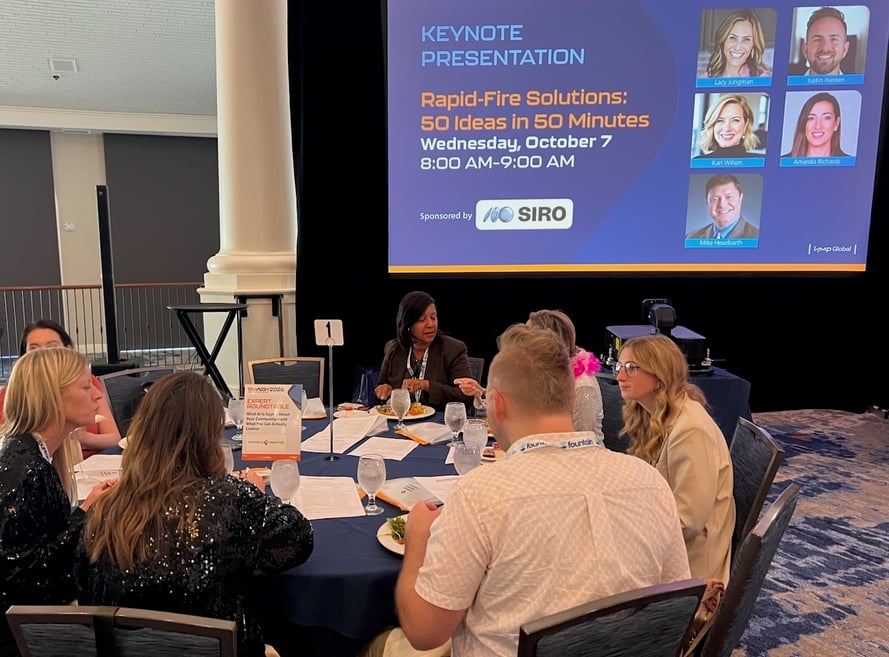
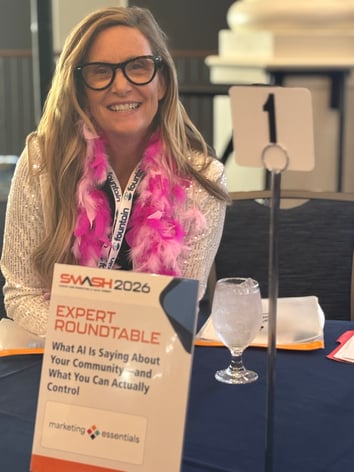
Mary Tangeman, COO at Marketing Essentials, and I also facilitated a peer roundtable, “What AI Is Saying About Your Community — and What You Can Actually Control,” with an engaged group of senior living professionals who were ready to share what’s working and what isn’t.
We started with how much family search has changed. Gartner projects traditional search volume will drop 25 percent by the end of 2026, and ChatGPT alone had 900 million weekly users early this year. Instead of clicking through a list of Google results, more adult children are asking AI tools directly, asking follow-up questions and forming opinions about a community before they ever visit its website. Strong SEO still gets you into that conversation, but it no longer guarantees how the conversation goes. That’s where AEO and GEO come in.
What made the discussion so valuable was how much everyone at the table learned from one another. Three themes stood out:
-
Reviews with specifics. The group traded ideas for generating more reviews and encouraging families to mention details like the memory care team, the culinary program or a favorite therapist. Those specifics are exactly what AI looks for when deciding how to describe a community.
-
Third-party voices. AI builds its picture of a community from reviews, placement sites, local “best of” lists and online forums, and those outside voices often carry more weight than anything a community says about itself.
-
Answer-ready website content. Many agreed that websites now need to be written differently. Content now has to answer families’ questions clearly and specifically enough for AI to find, understand and use. For many communities, that likely means an update to the website is due.
Our roundtable worksheet pointed to a few more moves worth making: getting local signals like your Google Business Profile and listings right (the cheapest fix and the most often overlooked), and continuing to invest in email, events and referral relationships, since AI visibility adds to your pipeline rather than replacing what’s already filling it.
Each attendee left with a commitment: one thing they’d change in the next 30 days. You can do the same. Pick one:
- Ask your happiest families to mention specifics in their reviews, like the memory care team or the culinary program.
- Check your Google Business Profile and listings for accuracy.
- Rewrite one key web page so it answers a question families actually ask.
No one can fully control what AI says about their community, but more is within reach than most people think.
Let’s Build Your Plan
You don’t have to figure out AI on your own. The families you want to reach are changing how they search, and you can change how you show up for them. Whether you’re sorting out where AI fits in your sales process, how to tell your community’s story or how families are finding you today, a clear plan makes the next step easier.
We’d love to help you build a plan for your organization. Let’s chat.